Organic Coconut Sugar from Indonesia: From Blossom to Crystal
How organic coconut sugar is made in Java, from twice-daily sap tapping to golden crystals. The real story behind Indonesia's coconut blossom sugar.
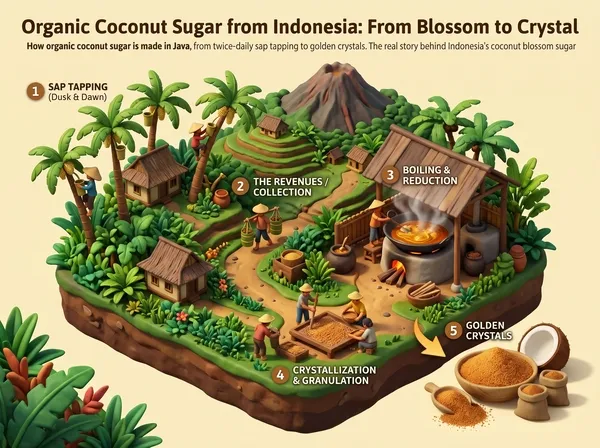
The day starts before sunrise in the villages of Banyumas, Central Java. A farmer the locals call a penderes, a sap tapper, ties a row of bamboo tubes to his waist and walks to the first palm. By the time most of the world has had its first coffee, he has already climbed several trees.
He is not after coconuts. He is after something most people never see: the sweet sap that drips from the palm's flower.
This is where organic coconut sugar from Indonesia begins. And it begins in a place that matters. According to Indonesia's public broadcaster RRI, Indonesia supplies about 90% of the world's coconut sugar, and roughly 80% of that comes from Greater Banyumas: Banyumas, Cilacap, Purbalingga and Banjarnegara (RRI, June 2026)
Not from the coconut, but from the blossom
A common mistake is to think coconut sugar comes from the fruit. It does not. It comes from the sap of the palm's unopened flower bud, the inflorescence (FoodWatch). That is why you will also see it sold as coconut blossom sugar.
The tapper gently bends and slices the tip of the flower stalk. Sap begins to drip into a collector hung beneath it. Farmers collect it twice a day, morning and afternoon (Food Ingredients First; DO IT Organic). Only selected flower bundles are tapped, so the palm keeps growing and other trees still bear coconuts.
A race against time
Fresh coconut sap is fragile. It holds roughly 10 to 15% sugar at a near-neutral pH, which makes it a perfect home for yeasts and bacteria. In a 2021 study, sap left at about 31 °C dropped from pH 6.77 to 3.74 in just six hours, and lost about a quarter of its sugar (Pandiselvam et al., 2021).
So the clock starts the moment the sap drips. Traditionally, a little lime (calcium oxide) is placed in the collector to slow fermentation (Secretaria et al., Coconut Community journal). Then the sap goes straight to the kitchen.
Fire, patience and a wooden paddle
In a simple village kitchen, the sap is poured into a wide pan over a wood fire. As the water evaporates, the sap thickens to a syrup at around 110 °C, then to a heavy paste at around 115 °C (same source). Now comes the craft: the cook stirs the thick caramel continuously as it cools, until it breaks into fine, golden granules.
Nothing is bleached or refined. The color, a warm brown, and the gentle caramel aroma come from the cooking itself. In Java this granulated form is known as gula semut, "ant sugar", because the fine crystals look like tiny ants.
What makes it organic
The word "organic" is not a story. It is a certified system. For coconut sugar it means the palms grow without synthetic fertilizers or pesticides, the tapping and cooking avoid prohibited additives, and every step is inspected and traceable.
In Banyumas, organic-certified cooperative members receive an incentive of around IDR 5,000 per kilogram, a small premium that rewards the extra care (RRI). It also explains why serious exporters invest in testing: RRI reports that four palm sugar containers were rejected in Germany during the pandemic after refined-sugar contamination was found. Purity is the product.
The tapper's future
Traditional coconut palms can grow up to 30 metres tall, and climbing them twice a day is demanding and risky work. Fewer young people want to do it. One answer now being planted across Central Java is the dwarf Genjah coconut, which stands around 3 metres and starts producing sap after about three years instead of six (DO IT Organic). Indonesia's Ministry of Agriculture has supplied 10,000 dwarf seedlings to the Banyumas program (RRI).
Shorter trees mean safer work, and a craft that can pass to the next generation.
From a village kitchen to your production line
Every bag of organic coconut sugar we export carries that morning walk, that race against fermentation, and that patient stirring. For buyers, it means a sweetener with a clear origin and a story your customers can trust.