Indonesian Organic Coffee: A Journey Through Its Origins
From Java in 1699 to the Gayo highlands and Bali's Kintamani, discover the history, regions and wet-hulled process behind Indonesian organic coffee.
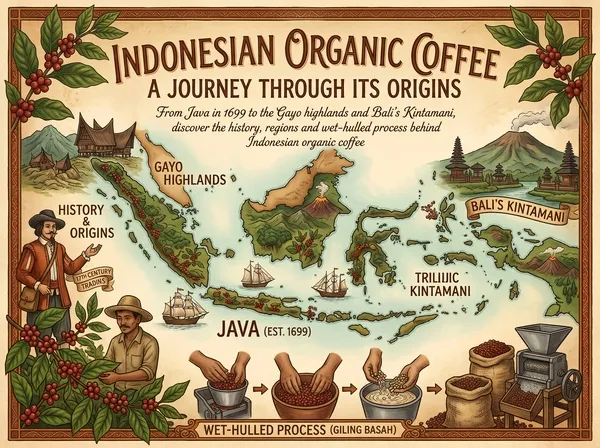
In 1696, a Dutch governor in India sent a shipment of coffee seedlings to Batavia, today's Jakarta. A flood destroyed them. Three years later, in 1699, a second shipment arrived, and this time the plants took root in Java's volcanic soil (Wikipedia: Coffee production in Indonesia).
By 1711, the first Javanese coffee was sailing to Europe. The island's name became so tied to the drink that "a cup of Java" is still slang for coffee three centuries later.
Today, Indonesian organic coffee grows across thousands of kilometres of islands, each with its own soil, altitude and character. Let's take the journey.
A crisis that shaped a nation's coffee
In the late 1800s, coffee leaf rust swept through Indonesia and destroyed much of its arabica. The Dutch replanted with liberica, then robusta, which reached East Java in 1900 (same source). That history still shows in the numbers. The USDA estimates Indonesia's 2025/26 crop at 12.37 million 60-kg bags: 11.0 million robusta and 1.37 million arabica (USDA via CropGPT, May 2026).
Arabica is the smaller share, but it is where Indonesia's most celebrated origins live. And it is grown mostly by smallholders: over 90% of Indonesian coffee comes from small farms averaging about one hectare (Wikipedia).
Gayo, Aceh: the highland of the lake
In the far north of Sumatra, coffee grows on the hillsides around Takengon and Lake Laut Tawar. Coffee was first planted in the Gayo highlands in 1924. Smallholders grow it under shade trees, and Gayo arabica is protected as a Geographical Indication in Indonesia, the EU and the UK (Wikipedia).
Gayo is also a stronghold of certified organic coffee. Many lots are sold through cooperatives that hold both organic and Fairtrade certification. One example: the Gayo Women's Coffee Cooperative in Bener Meriah, with 394 smallholder members farming at 1,000 to 1,400 metres (Royal Coffee).
Kintamani, Bali: coffee guided by philosophy
On the highlands between Bali's volcanoes, farmers organize themselves in a subak abian, a traditional cooperative rooted in the Balinese philosophy of Tri Hita Karana: harmony between people, nature and the divine. This system tends to favor organic practices (Wikipedia).
In 2008, Kopi Arabika Kintamani Bali became Indonesia's very first registered Geographical Indication for coffee (Wikipedia: GIs in Indonesia). Bali has one harvest season, roughly July to September.
Toraja and Kalosi, Sulawesi
In the mountains of South Sulawesi, the Toraja highlands and the Enrekang district grow Sulawesi's high-altitude arabica, often traded under the name Kalosi. Kopi Arabika Toraja and Kopi Arabika Kalosi Enrekang both became Geographical Indications in 2013.
Flores, Java and beyond
On the island of Flores, Bajawa arabica earned its GI in 2012. Back where it all began, Java Preanger in West Java and Java Ijen-Raung in East Java were registered in 2013. In total, dozens of Indonesian coffees are now protected by GI, from Sumatra Mandailing to Baliem Wamena in Papua (Wikipedia: GIs in Indonesia).
Origin | Island | GI registered |
Kintamani Bali | Bali | 2008 |
Gayo | Sumatra | 2010 |
Flores Bajawa | Flores | 2012 |
Java Preanger | Java | 2013 |
Toraja | Sulawesi | 2013 |
Sumatra Mandailing | Sumatra | 2016 |
The secret of the Sumatran cup: wet-hulling
If one thing makes Indonesian coffee taste unlike anything else, it is giling basah, or wet-hulling.
In most coffee countries, beans are dried inside their parchment shell to around 11–12% moisture before hulling. In humid Sumatra, that could take weeks. So farmers dry the parchment for only a day or two, to around 35–40% moisture, then remove the shell while the bean is still soft. The naked bean then dries in two or three days to 11–12% (SpecialtyCoffee.id).
The result is the famous Sumatran profile: heavy, syrupy body, low acidity, and notes of earth, cedar, dark chocolate and spice. Higher-altitude lots, such as Gayo grown above 1,600 metres, keep more brightness (same source). Many Indonesian producers now also offer fully washed and natural lots for buyers who want a cleaner cup.
Why organic fits Indonesia
Small farms, shade trees, volcanic soil and traditions like subak abian make organic farming a natural extension of how much Indonesian coffee is already grown. Certification turns that tradition into proof a buyer can verify.
Every bag we export comes from one of these landscapes. Explore our green coffee range or read our guide to importing organic Indonesian coffee.