Café verde orgánico de Indonesia: guía de importación
Guía para tostadores sobre la importación de café verde orgánico de Indonesia: perspectivas de suministro, grados SNI, normas orgánicas de la UE y del USDA, y plazos del EUDR para diciembre de 2026.
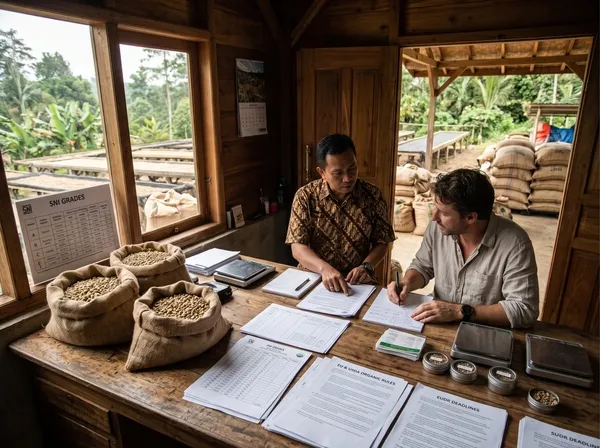
A roaster in Melbourne cups a Gayo sample and falls for it: dark chocolate, cedar, a body like syrup. The next question is not about flavor. It is: can I get this, certified organic, every year, without surprises at customs?
This guide answers that question for anyone buying organic green coffee beans from Indonesia.
1. Understand the supply picture
Indonesia is the world's fourth-largest coffee producer (SpecialtyCoffee.id). The USDA estimates the 2025/26 crop at 12.37 million 60-kg bags and forecasts 11.38 million bags for 2026/27, an 8% drop, mostly from robusta. Arabica stays near 1.37–1.38 million bags. Green coffee exports are forecast at 7.0 million bags for 2026/27, down from 7.84 million (USDA via CropGPT, May 2026).
What this means for you: certified organic arabica is a small slice of a small arabica crop. Contract early in the season and build a relationship with one exporter rather than chasing spot lots.
2. Learn the Indonesian grading system
Indonesian green coffee is graded under SNI 01-2907-2008, which counts defects in a 300 g sample (SpecialtyCoffee.id).
Grade | Total defect value (per 300 g) |
1 | up to 11 |
2 | 12–25 |
3 | 26–44 |
4a | 45–60 |
4b | 61–80 |
5 | 81–150 |
6 | 151–225 |
For specialty roasting, ask for Grade 1, triple-picked where offered, and request a cupping score from a licensed Q grader. Always agree on screen size and moisture (typically 11–12% for wet-hulled lots) in the contract.
3. Choose the process that fits your menu
• Wet-hulled (giling basah): the classic Sumatran cup, heavy body and low acidity (SpecialtyCoffee.id).
• Fully washed: cleaner and brighter; common for Java, Bali and Flores.
• Natural and honey: fruit-forward micro-lots, increasingly offered by Gayo and Bali producers.
4. Get the organic paperwork right
• EU. Since 1 January 2025, only control bodies recognised by the EU and listed under Regulation 2021/1378 may certify organic products exported to the EU (AGRINFO). Every shipment also needs an electronic certificate of inspection in the EU's TRACES system.
• United States. A USDA NOP certificate from an accredited certifier, and since the Strengthening Organic Enforcement rule, an NOP import certificate for each organic shipment.
• Fairtrade (optional). Many Gayo cooperatives hold combined Fairtrade and organic certification, as with the Gayo Women's Coffee Cooperative (Royal Coffee).
5. Prepare for EUDR
The EU Deforestation Regulation covers coffee. Under Regulation (EU) 2025/2650, it applies from 30 December 2026 for large and medium operators, and from 30 June 2027 for most micro and small enterprises (European Commission, Access2Markets).
The operator who first places coffee on the EU market must submit a due diligence statement proving it was grown on land not deforested after 31 December 2020. In practice, your exporter should be able to supply geolocation of the farm plots behind each lot. With over 90% of Indonesian coffee grown by smallholders (Wikipedia), ask now how your supplier maps its farmers. EUDR rules have changed several times, so check the latest guidance before each contract.
6. Plan logistics
Green coffee ships under HS code 0901.11 (not roasted, not decaffeinated), usually in 60 kg jute bags with GrainPro liners or in bulk liner bags. Main export ports are Belawan (Medan) for northern Sumatra, Panjang (Lampung) for robusta, and Tanjung Perak (Surabaya) for Java, Bali and eastern islands. Ask for pre-shipment samples (PSS) and approve them before loading.
Importer's checklist
• ☐ Grade, screen size, moisture and process written into the contract
• ☐ Approved pre-shipment sample and cupping score
• ☐ Organic certificate from an EU-recognised or USDA-accredited body
• ☐ Certificate of inspection (EU TRACES) or NOP import certificate (US)
• ☐ EUDR geolocation and due diligence data for EU shipments
☐ Phytosanitary certificate, certificate of origin, packing list and bill of lading