Organic Coconut Sugar Supplier from Indonesia: Buyer's Guide
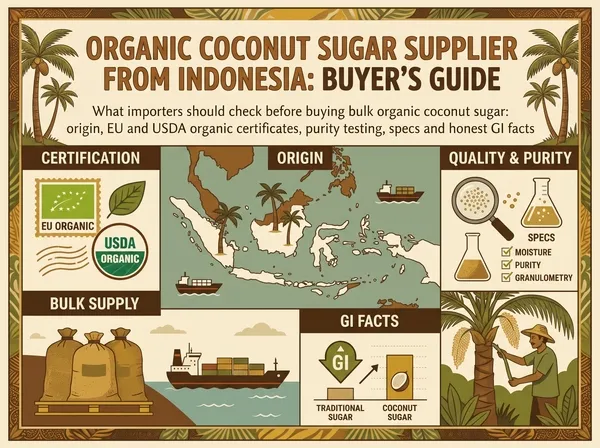
What importers should check before buying bulk organic coconut sugar: origin, EU and USDA organic certificates, purity testing, specs and honest GI facts.
Picture a product developer in Hamburg holding two samples of coconut sugar. Both are golden, both smell of caramel, both carry an organic logo. One will run smoothly through her factory for years. The other will be stopped at the port.
The difference is rarely visible in the bag. It sits in the paperwork, the lab report and the supplier's relationship with the farmers. This guide explains what to check when choosing an organic coconut sugar supplier in Indonesia.
1. Start with origin: why Indonesia, and why Java
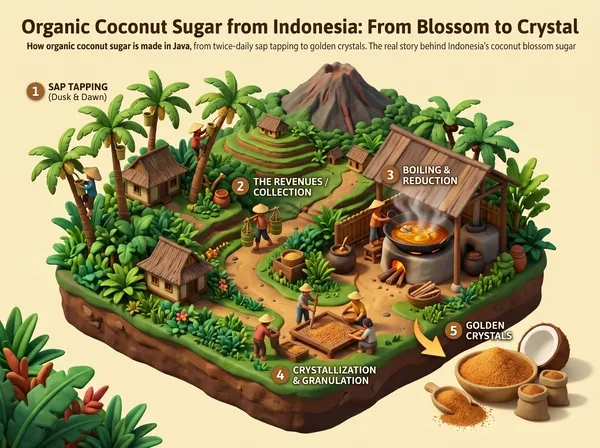
Indonesia supplies about 90% of the world's coconut sugar, and roughly 80% of it comes from Greater Banyumas in Central Java (RRI, June 2026). Buying close to that source means shorter supply chains, more stable volumes and a supplier who can walk you to the farms.
Ask any supplier three questions: Which villages does the sap come from? How many tappers supply you? Can we visit?
2. Check the organic certificate, not just the logo
The rules changed in 2025, and many buyers have not caught up.
European Union. Under Regulation (EU) 2018/848, imports moved from "equivalence" to "compliance": producers outside the EU must follow the same rules as EU producers. Since 1 January 2025, only control bodies recognised by the EU and listed in Regulation 2021/1378 may certify organic products exported to the EU (AGRINFO). Ask for the certificate, the name of the control body, and confirm it is on the current list for Indonesia.
United States. Ask for a USDA NOP organic certificate issued by a USDA-accredited certifier, and check the operation in the USDA Organic Integrity Database.
Smallholder groups. Most coconut sugar comes from many small farms, so certification is often held by a group or cooperative. Ask how internal inspections work and how many members are covered.
3. Demand proof of purity
Coconut sugar's biggest commercial risk is adulteration with cane or refined sugar. RRI reports that four palm sugar containers were rejected in Germany during the pandemic after refined-sugar contamination was found (RRI).
A serious supplier will provide, per lot:
A certificate of analysis (moisture, color, particle size, sucrose and reducing sugars, microbiology).
An authenticity test from an accredited lab, such as stable isotope analysis, which can distinguish palm sugar from cane sugar.
Pesticide residue screening for organic lots.
Traceability from bag to collection point.
Agree on the specification sheet before the first order, not after.
4. Know the product forms
Form | What it is | Typical use |
Granulated (gula semut) | Fine crystals, stirred while cooling | Baking, beverages, cereals, retail packs |
Block or cake sugar (gula cetak) | Poured into molds | Asian cuisine, foodservice |
Coconut syrup or nectar | Sap reduced to a syrup, not crystallized | Sauces, drinks, dressings |
Granules can usually be sieved to different mesh sizes for your application; ask for a sieve analysis.
5. Talk about nutrition honestly
Coconut sugar is often sold as "low GI". The facts are more nuanced. The figure of GI 35 comes from a single study of 10 volunteers in the Philippines, while testing at the University of Sydney reported a GI of 54, just inside the low-GI range (FoodWatch). Coconut sugar is still mostly sucrose, about 78–89 g per 100 g, with small amounts of minerals and inulin (same source).
For EU labels, nutrition and health claims must comply with Regulation (EC) 1924/2006. Sell coconut sugar for what it truly is: an unrefined, single-ingredient sweetener with a caramel flavor and a traceable origin.
6. Look at the people behind the supply
Sap tapping is skilled, physical work. Good suppliers pay organic premiums (Banyumas cooperatives pay members around IDR 5,000 per kg for organic) and invest in safer dwarf coconut palms (RRI). These programs are not charity. They protect your future supply.
Buyer's checklist
• ☐ Valid EU and/or USDA organic certificate, from a recognised control body
• ☐ Lot-specific certificate of analysis and authenticity test
• ☐ Agreed specification sheet and sieve size
• ☐ Traceability to farmer groups
• ☐ Clear Incoterms, packaging, MOQ and lead time